
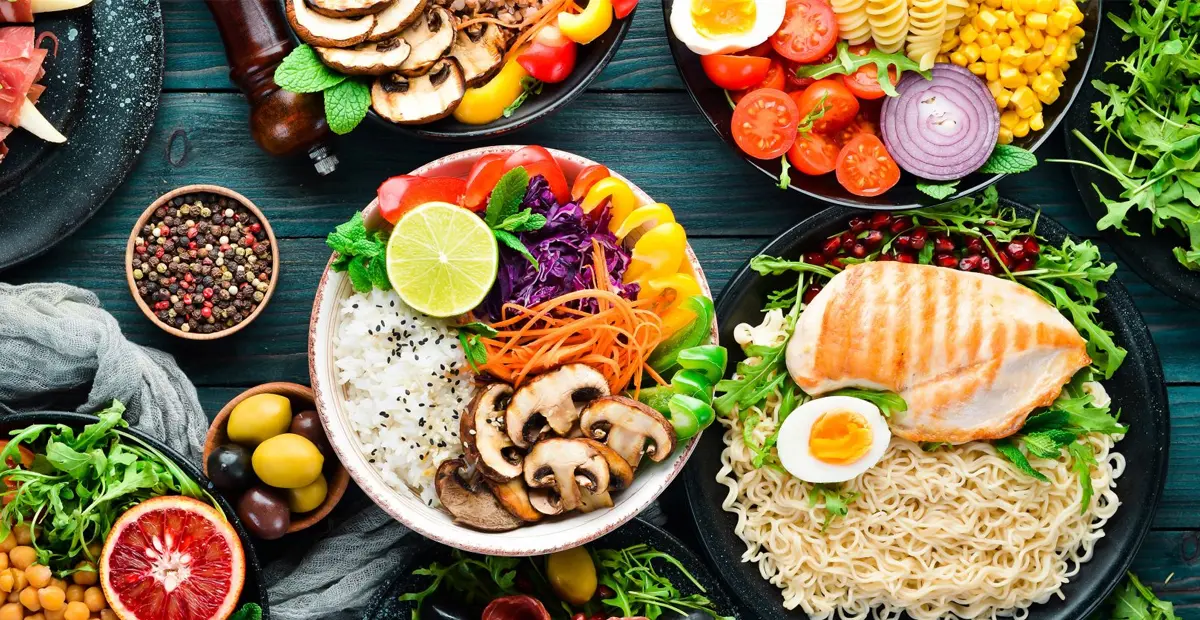
You are what your food system feeds you
How the next frontier of food innovation is rewriting the biology of ageing and why Switzerland is becoming the place where it happens.
Consider the paradox at the heart of modern life: we have never known more about nutrition and yet metabolic disease, accelerated biological ageing and diet-related chronic illness are growing faster than ever. The gap between what we know and what we eat, grow, process and choose is costing us years of healthy life. Closing it is the defining food challenge of our century.
Food innovation for healthspan is rising to meet this challenge, not with another superfood, not with a supplement promising extra years, but by fundamentally rethinking how food is designed and delivered, so the default meal, the everyday staple, the affordable grocery, becomes a vehicle for biological resilience rather than a quiet accelerant of decline.
Eating for your epigenome, not just your waistline
Nutrigenomics has redrawn the map. What you eat doesn’t just fuel your body, it speaks directly to your genome, altering DNA methylation patterns and switching genes on and off. A Mediterranean diet slows epigenetic ageing, while ultra-processed food accelerates it. The mechanism is no longer a mystery: oxidative stress, chronic inflammation, and microbiome disruption feed directly back into the epigenome and into how fast you age.
This is the biological logic that food innovation must now answer. The question is no longer just ‘is this food nutritious?’ It is: ‘what is this food doing to the pace of ageing in the people who eat it?’
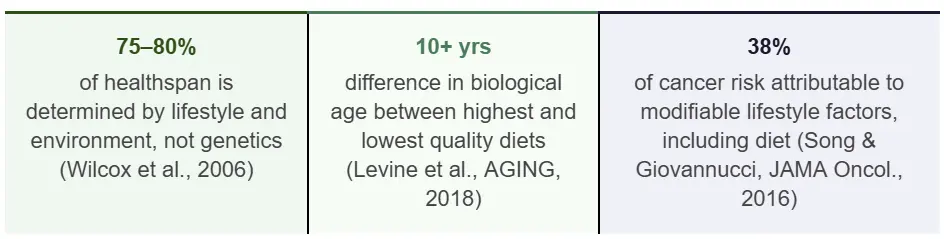
Key figures: the science linking food to biological ageing and healthspan
From farm to phenotype: Where innovation is happening
The food innovation landscape has matured beyond the buzzword stage. Precision fermentation, biofortification, microbiome-targeted formulation and AI-driven personalised nutrition are moving from research labs into the food supply and the most compelling progress is happening at the intersection of food science and longevity biology.
Specific polyphenols, such as quercetin, fisetin, urolithin A, are being shown to activate autophagy pathways linked to cellular clean-up and reduced senescence. And Stanford research led by Justin and Erica Sonnenburg found that high-fibre and high-fermented-food diets both increase microbial diversity and reduce inflammatory markers (Dahl et al., Cell, 2021). The implication for food design is profound: diversity of plant inputs, not just nutrient quantity, may be the metric that matters most for biological resilience.
Three fronts where food Innovation is moving fastest
→ Postbiotics & targeted fermentation — engineering gut metabolites that directly modulate inflammation and cellular ageing
→ Biofortification — developing crop varieties with measurably higher levels of healthspan-relevant micronutrients→ Personalised nutrition platforms — using continuous glucose monitors, microbiome sequencing, and AI to build genuinely individual dietary protocols
The protein problem and the innovation opportunity
No conversation about food and healthspan is complete without muscle. Sarcopenia, the progressive loss of skeletal muscle mass and function with age, is one of the most underappreciated drivers of mortality and disability. The World Health Organisation estimates that sarcopenia affects up to 50% of people over 80 and it begins its slow advance in our thirties.
Getting the right proteins, the right polyphenols, the right fibre diversity into the diets of the 80% who don’t eat well, not the 20% who already optimise, requires a complete rethinking of the food system. That means policy, investment, ecosystem collaboration and, above all, a willingness to treat food not as a commodity but as a public health infrastructure.
The healthspan lens: A new standard for the industry
What would it mean for a food company to genuinely compete on healthspan outcomes? Clinical trials measuring biological age, not just biomarkers. Transparency about ultra-processing and its epigenetic consequences. R&D pipelines oriented around compressing morbidity, pushing disease to the very end of life, rather than reformulating for the next regulatory cycle.
A handful of companies are moving this way, mostly in premium and functional food. But the real goal is not expensive longevity products for affluent early adopters. It is making the default – the everyday staple, the school meal, the hospital tray – an instrument of biological resilience.
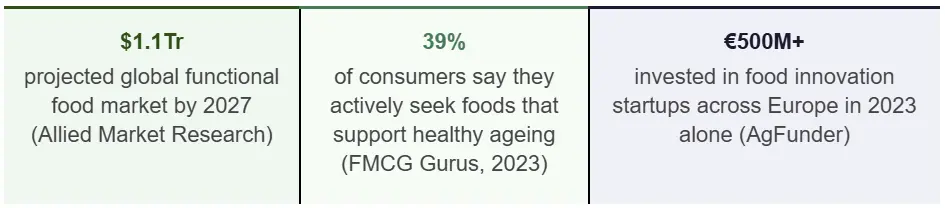
The market is moving: food innovation and healthy ageing by the numbers
Switzerland as a food innovation nation and the architect behind the ambition
Switzerland has all the ingredients for food innovation leadership: world-class institutions from ETH Zurich to EPFL, global food companies, a thriving startup culture and a precision-obsessed regulatory environment. What it has historically lacked is the connective tissue. That is what Christina Senn-Jakobsen is building.
As CEO of Swiss Food & Nutrition Valley, Christina brings a rare combination of scientific depth (Masters in Food Science from Copenhagen and European Food Studies from Wageningen) and systemic thinking honed across twelve years at Mondelez and a career spent moving between Big Food, startups, academia and government. In 2024, she joined the “Magnificent 99+1 Shaping Global FoodTech” list. The not-for-profit she leads operates through five Impact Platforms, uniting corporations, universities, SMEs and startups around food system transformation. Her conviction is simple and uncompromising: this is a team sport. In a world where the gap between food science and food reality is costing us years of healthy life, the ability to build the field, not just play in it, may be the most important innovation of all.