The night shift your body can’t afford to skip
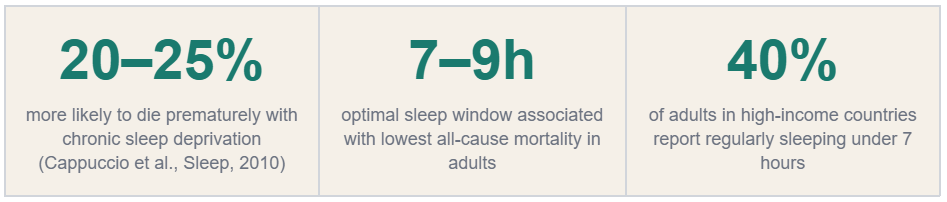
Somewhere along the way, we started treating sleep as optional, a variable we can compress when deadlines loom, sacrifice when ambition calls and “catch up on” at the weekend. This is one of the most consequential mistakes in modern health culture and the science is now unambiguous about the cost.
Sleep is not a passive state. Every night, the brain and body execute an intricate biological programme: flushing toxic metabolic waste, consolidating memory, recalibrating the immune system, repairing cardiovascular tissue and resetting the hormonal architecture that governs metabolism and stress response. Miss enough of it, or degrade its quality over years, and you do not simply feel tired. You accelerate biological ageing.
THE MECHANISM
What actually happens when you sleep
The discovery of the glymphatic system reshaped our understanding of sleep. During deep slow‑wave sleep, cerebrospinal fluid flushes amyloid‑beta and tau, the proteins that drive Alzheimer’s pathology, through channels between brain cells. This cleaning process operates almost exclusively during unconsciousness (Xie et al., Science, 2013).
In parallel, the immune system runs its night shift: natural killer cells peak, cytokine signalling coordinates repair, and inflammatory markers such as IL‑6 and CRP fall with adequate sleep and rise when it is restricted. Besedovsky et al. (Pflügers Archiv, 2012) showed that sleep loss weakens vaccine response – clear evidence that immunity is sleep‑dependent.
There is also an epigenetic dimension. Chronic short sleep alters DNA methylation in genes regulating inflammation, circadian rhythms and metabolism – changes that mirror accelerated biological ageing (Carroll et al., Sleep, 2023).
Poor sleep doesn’t just feel like ageing. It is ageing — measurable at the molecular level through shifts in DNA methylation patterns.
BEYOND DURATION
Architecture matters as much as hours
We fixate on sleep duration, but its internal architecture matters just as much for healthspan. A full night cycles through four to six 90‑minute loops of light sleep, deep slow‑wave sleep (SWS) and REM, each with distinct functions. SWS drives physical repair and glymphatic clearance; REM supports emotional memory, mood regulation and the psychological resilience that buffers chronic stress, a major accelerator of biological ageing.
Several factors disrupt this architecture. Alcohol may ease sleep onset but fragments REM, impairing emotional and cognitive recovery. Irregular schedules, artificial evening light, late meals and chronic stress compress or break up SWS. The result: someone can record eight hours yet remain biologically under‑recovered.
Heart rate variability (HRV) during sleep has become one of the most sensitive markers of sleep quality and autonomic nervous system health. Lower overnight HRV correlates with accelerated cardiovascular ageing and reduced stress resilience – two core determinants of healthspan (Brindle et al., Sleep, 2018).
TIMING
When you sleep is as important as how long
The circadian clock, the master timekeeper in the suprachiasmatic nucleus, driven by light, coordinates nearly every organ system. When sleep timing drifts from the light–dark cycle, the effects go far beyond fatigue. Shift workers, chronic night owls and people with high social jet lag show consistently higher markers of metabolic disease, cardiovascular risk and inflammation (Roenneberg et al., Current Biology, 2012).
Chronobiology research shows that circadian misalignment decouples peripheral clocks in the liver, pancreas and heart from the brain’s master clock, disrupting glucose metabolism, lipid regulation and blood‑pressure rhythms – changes with direct implications for disease risk.
The healthspan cost of chronic circadian misalignment is now estimated to be comparable to poor diet or physical inactivity.
HEALTHSPAN ACTION
Three evidence-based moves
01 — Anchor your wake time. A consistent wake time, including weekends, is the single most powerful lever for stabilising circadian rhythm. It builds sleep pressure naturally and protects slow-wave sleep architecture.
02 — Protect light exposure. Morning bright light (10–30 minutes within the first hour of waking) sets the circadian phase and promotes melatonin onset at the appropriate time in the evening. Blue-light blocking in the two hours before sleep has a measurable impact on sleep onset latency and SWS quality.
03 — Track quality, not just quantity. Wearable HRV and sleep-stage data, while imperfect at the individual level, offer trends over time that reveal whether lifestyle interventions are improving biological recovery. A rising average overnight HRV over weeks is a meaningful healthspan signal, more meaningful than any single night’s reading.
EXPERT VOICE
Translating sleep science into prevention
The science above isn’t theoretical. It is already shaping real tools for prevention and early detection. Few researchers embody this translation from mechanism to application more clearly than Caroline Lustenberger, PD Dr. sc., neuroscientist and lecturer at ETH Zurich, where she leads the Sleep Lab within the Neural Control of Movement Lab. For more than 16 years, her work has examined how sleep supports brain and body health across the life‑ and healthspan, combining mechanistic studies with digital and real‑world approaches that bring sleep science into daily life.
Her research bridges two worlds rarely connected: the biology of sleep and the architecture of prevention. As co-founder of HERENCIA Solutions AG, an ETH spin‑off focused on early Alzheimer’s detection and prevention, she is turning laboratory insights into practical tools that could alter the trajectory of a major neurodegenerative disease.
Her book Dieses Buch ist zum Einschlafen (Beobachter Edition, Ringier, 2024) brings this science to a wider public because understanding sleep is the first step to protecting it.
KEY REFERENCES
Cappuccio FP et al. Sleep duration and all-cause mortality: a systematic review and meta-analysis of prospective studies. Sleep. 2010;33(5):585–592.
Xie L et al. Sleep drives metabolite clearance from the adult brain. Science. 2013;342(6156):373–377.
Besedovsky L et al. Sleep and immune function. Pflügers Archiv. 2012;463:121–137.
Carroll JE et al. Epigenetic aging and immune senescence in women with insomnia symptoms. Sleep. 2023;46(1).
Brindle RC et al. Actigraphy-based estimates of sleep quality and HRV. Sleep. 2018;41(2).
Roenneberg T et al. Social jetlag and obesity. Current Biology. 2012;22(10):939–943.