

After a heart attack: why women in Switzerland still leave hospital less protected
Surviving a heart attack is only the first step. The care that follows shapes how long, and how well, a person lives. Twenty years of Swiss data show that women still leave hospital with less protective treatment than men, and the gap is widest in younger women.
Heart attack care in Switzerland has improved greatly. Patients reach hospital faster, most have an angioplasty to reopen the blocked artery, and more people survive.
But a heart attack is not a one-off event. It is usually a sign of coronary artery disease, a narrowing of the arteries that supply the heart. Survivors remain at considerable risk of another heart attack and of death. The treatment that follows, called secondary prevention, aims to lower that risk (Berther et al., 2026).
In September 2026, a new analysis of Switzerland’s national heart attack registry asked a simple question: do women and men leave hospital with the same protection? For two decades, the answer has been no.
This matters for healthspan, not just survival. A second heart attack, heart failure or a stroke can take away years of independence. Women in Switzerland live almost four years longer than men, but their healthy life expectancy is only around four months longer (Federal Statistical Office, 2025).
What 20 years of Swiss data show
The study used AMIS Plus, Switzerland’s national heart attack registry, which has collected data since 1997. Researchers analysed 34,612 people treated for a heart attack in Swiss hospitals between 2003 and 2022. One in four was a woman (Berther et al., 2026).
The team checked whether each patient left hospital on all five types of medicine recommended at the time. Researchers call this “optimal medical therapy”. Two are antiplatelet medicines, which help prevent blood clots: aspirin and a second antiplatelet drug. The others are a cholesterol-lowering medicine, a beta-blocker to ease the heart’s workload, and an ACE inhibitor or ARB to lower blood pressure and protect the heart.
Prescribing at hospital discharge: women and men compared
Percentage of heart attack patients prescribed each medicine class in the Swiss AMIS Plus registry, 2003-2022
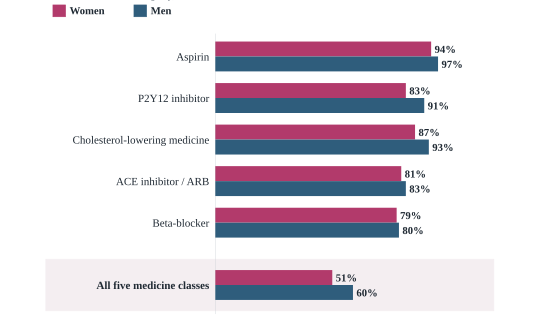
The five-medicine measure reflects recommendations applicable during the study period. Current treatment decisions depend on individual circumstances and guidelines.
Source: Berther et al. (2026), AMIS Plus registry, n = 34,612 patients (8,699 women, 25,913 men).
The main findings
- Care improved overall. The share of patients leaving hospital on all five medicines rose from 36% to 60%. Use of cholesterol-lowering medicine rose from 69% to 93%.
- Women were less protected. Only 51% of women left hospital on all five medicines, compared with 60% of men. Women received four of the five types less often. Only beta-blocker use was similar.
- Younger women had the largest gap. Among patients under 50, 55% of women and 65% of men received all five.
- The gap has not closed. It was 14 percentage points in 2003, almost disappeared by 2016, then widened again to 12 points by 2022. For the most important pairing, antiplatelet medicines plus cholesterol-lowering medicine, it shrank steadily from 18 to 10 points.
Women in the study were, on average, seven years older than men and had more other conditions, such as diabetes and kidney disease. But this did not explain the gap. It remained after the researchers took age, other illnesses and treatment into account (Berther et al., 2026).
Some good news
An earlier AMIS Plus study looked at the most serious type of heart attack, known as STEMI. In 2002, women typically reached hospital about an hour later than men after their symptoms began. By 2019, once age and health were taken into account, this delay had disappeared (Foster-Witassek et al., 2023). This is encouraging progress. But the newer registry analysis highlights another important question: whether women receive the same protection when they leave hospital.
Why this matters for long-term health
After a heart attack, the focus moves from saving heart muscle to protecting the years ahead. Two types of medicine have especially strong backing. European Society of Cardiology (ESC) guidelines recommend both antiplatelet medicines and intensive cholesterol lowering for almost all heart attack survivors (Byrne et al., 2023). So the remaining 10-point gap in this pairing means many women start their recovery with less protection.
A prescription is only the first step. A Swiss study of health insurance data followed 4,349 people after a heart attack. Many did not take their medicines regularly, and women were less likely to receive cholesterol-lowering medicine. People who took their antiplatelet and cholesterol-lowering medicines consistently had a significantly lower risk of death (Huber et al., 2019). This was an observational study, so it shows a link rather than proof of cause, but it points the same way as the guidelines.
An international review of 28 studies also found that women were less likely than men to keep taking cholesterol-lowering medicine. For other heart medicines, there was no clear difference (Bots, Inia and Peters, 2021).
Those extra years matter. On average, women in Switzerland live to 85.4 but stay in good health only until about 72 (Federal Statistical Office, 2025). Another heart attack, heart failure or a stroke could add to the years they spend in poor health. Helping women get and stay on effective treatment is one practical way to protect healthy years.
Why does the gap exist?
The honest answer is that no one knows for sure. The registry recorded which medicines doctors prescribed, but not why they left one out. The study authors discuss several possible reasons (Berther et al., 2026).
- Age and other illnesses. Women who have heart attacks tend to be older and to have more health problems, which can complicate treatment decisions. But this explains only part of the gap.
- Different types of heart attack. Some heart attacks happen without a seriously blocked artery, a condition known as MINOCA. It seems more common in younger women and may affect prescribing. Yet in the Swiss data, women were prescribed less even after an angioplasty.
- Gaps in research and awareness. Women have long been under-represented in heart research. Doctors may doubt how well some medicines work in women, worry more about side effects, or underestimate women’s risk. Unconscious bias may also play a part.
Research from Canada adds another clue. There, women under 55 were less likely than men to start the recommended medicines after a heart attack. Once they started, they took them as reliably as men did (Smolina et al., 2015). This suggests that the decision at discharge matters a great deal.
Keeping the findings in proportion
Two points matter here. First, guidelines have changed. The 2023 ESC guidelines give their strongest recommendation for beta-blockers and ACE inhibitors only to certain patients. These include people whose heart pumps less well, or who have diabetes, kidney disease or high blood pressure (Byrne et al., 2023). So missing one of the five medicines is not always poor care. That makes the gap in antiplatelet and cholesterol-lowering medicines the more telling figure.
Second, the Swiss study only looked at prescriptions on leaving hospital. It could not show what patients took later, or whether the gap led to more heart attacks or deaths (Berther et al., 2026). It shows a consistent difference in care, not how much harm that difference causes.
Women’s heart health in Switzerland
These figures cover adults of all ages, not just women in midlife. They provide useful context, but they cannot tell us how much perimenopause contributes to this difference.
A Swiss study offers a more specific perspective. The prospective Zurich Study followed 168 women from age 21 to 50. At age 50, hot flushes, night sweats and sleep disturbances were significantly more common among perimenopausal and postmenopausal women. Irritability and nervousness were more common during perimenopause, but this association was explained by neuroticism—a tendency towards negative emotions—measured earlier in life. The transition itself was not associated with changes in the prevalence of major depressive episodes or anxiety disorders.
Heart and circulatory disease is the leading cause of death in Switzerland. In 2023, it caused 28% of all deaths, and more women (11,017) than men (9,359) died from it (Federal Statistical Office, 2024).
These numbers need careful reading. Women who died from heart and circulatory disease were, on average, 87 years old, six years older than men. In midlife, cancer is the bigger threat: it caused half of all deaths among women aged 45 to 64 (Federal Statistical Office, 2024). So heart disease in women mostly affects later life, but not only later life.
The registry reflects this. Women with heart attacks were, on average, 71 years old, compared with 64 for men. Almost half were over 75. Yet 579 women under 50 were also treated, and this is where the prescribing gap was largest (Berther et al., 2026).
That is why this is a healthy ageing issue. For most women, good follow-up care helps them stay active and independent in their 60s, 70s and 80s. For younger women, it protects decades of life ahead.
What women should know about follow-up care
None of this means that an individual woman’s care is wrong. Treatment depends on personal circumstances, and some medicines are rightly left out for some patients. But knowing what good follow-up looks like helps women take an active part in their recovery. These points are worth discussing with a cardiologist or family doctor.
Before you leave hospital
- Know your medicines and why you take them. Ask for a written list of your medicines. It should say what each one does and how long to take it. If an antiplatelet or cholesterol-lowering medicine is not on the list, it is reasonable to ask why.
- Ask about cardiac rehabilitation. It combines supervised exercise, education and support to change habits. In Switzerland, it is offered as a three- to four-week stay in a rehabilitation centre or as a 4- to 12-week outpatient programme. Afterwards, around 140 local heart groups offer long-term support (Swiss Heart Foundation, n.d.). If no one mentions rehabilitation, ask.
In the months and years that follow
- Don’t stop on your own. People often stop heart medicines because of side effects or doubts. Talk to your doctor or pharmacist first. There is often an alternative.
- Keep track of your cholesterol. Ask what your target level is and when it will be checked. This is one of the areas where women are more likely to miss out.
- Look at the wider picture. Blood pressure, diabetes, smoking, inactivity and stress all affect the risk of another heart attack. Regular check-ups are a chance to tackle them together.
- Know the warning signs and act fast. The classic sign is pressure or pain in the centre of the chest, sometimes spreading to the arms, neck or jaw. But women often have no chest pain. Breathlessness, unexplained nausea or vomiting, or pressure in the chest, back or abdomen may be the only signs (Canton of Basel-Stadt, n.d.). In Switzerland, call 144 straight away.
Family members can help too. They can join appointments, help keep track of medicines, or encourage a woman to put her own recovery first.
The bottom line
Heart attack care in Switzerland has improved a great deal. But the latest national data show a gap that has not gone away: women, especially younger women, are still less likely to leave hospital with the full set of recommended medicines.
The reasons are not fully clear, and the study cannot tell us how much harm the gap causes. It does show that equal guidelines have not yet led to equal care. For women, the message is to see leaving hospital as the start of recovery, not the end. Know your medicines, ask about any that are missing, take up rehabilitation and keep your follow-up appointments.
This article is for general information and does not replace personal medical advice. If you have had a heart attack, talk to your doctor about your treatment.
Key References
- Berther, L., Radovanovic, D., Roffi, M., Stähli, B., Pedrazzini, G. and Rickli, H. (2026) ‘Sex differences in prescription patterns of secondary prevention pharmacotherapy in patients with acute myocardial infarction: a 20-year insight from the AMIS Plus registry’, Swiss Medical Weekly, 156, 4681. Available at: https://doi.org/10.57187/4681
- Bots, S.H., Inia, J.A. and Peters, S.A.E. (2021) ‘Medication adherence after acute coronary syndrome in women compared with men: a systematic review and meta-analysis’, Frontiers in Global Women’s Health, 2, 637398. Available at: https://doi.org/10.3389/fgwh.2021.637398
- Byrne, R.A., Rossello, X., Coughlan, J.J. et al. (2023) ‘2023 ESC Guidelines for the management of acute coronary syndromes’, European Heart Journal, 44(38), pp. 3720–3826. Available at: https://doi.org/10.1093/eurheartj/ehad191
- Canton of Basel-Stadt, Department of Health (n.d.) Erste Hilfe – so geht’s. Available at: https://www.bs.ch/gd/md/gesundheitsschutz/firstresponder/erste-hilfe-so-gehts
- Federal Statistical Office (2024) Todesursachenstatistik 2023. Neuchâtel: Federal Statistical Office. Available at: https://statistik.admin.ch/de/news/2024-0101
- Federal Statistical Office (2025) Schweizerische Gesundheitsbefragung 2022: Gesundheit und Geschlecht. Gesundheit in der Schweiz: Grosse Unterschiede zwischen den Geschlechtern. Press release, 19 May. Neuchâtel: Federal Statistical Office. Available at: https://dam-api.bfs.admin.ch/hub/api/dam/assets/35269335/master
- Foster-Witassek, F., Rickli, H., Roffi, M., Pedrazzini, G., Eberli, F., Fassa, A., Jeger, R., Fournier, S., Erne, P. and Radovanovic, D. (2023) ‘Reducing gap in pre-hospital delay between women and men presenting with ST-elevation myocardial infarction’, European Journal of Preventive Cardiology, 30(11), pp. 1056–1062. Available at: https://doi.org/10.1093/eurjpc/zwac294
- Huber, C.A., Meyer, M.R., Steffel, J., Blozik, E., Reich, O. and Rosemann, T. (2019) ‘Post-myocardial infarction (MI) care: medication adherence for secondary prevention after MI in a large real-world population’, Clinical Therapeutics, 41(1), pp. 107–117. Available at: https://doi.org/10.1016/j.clinthera.2018.11.012
- Smolina, K., Ball, L., Humphries, K.H., Khan, N. and Morgan, S.G. (2015) ‘Sex disparities in post-acute myocardial infarction pharmacologic treatment initiation and adherence: problem for young women’, Circulation: Cardiovascular Quality and Outcomes, 8(6), pp. 586–592. Available at: https://doi.org/10.1161/CIRCOUTCOMES.115.001987
- Swiss Heart Foundation (n.d.) Rehabilitation nach Herzerkrankung [Rehabilitation after heart disease]. Available at: https://swissheart.ch/erkrankungen-und-notfall/leben-mit-der-krankheit/rehabilitation-nach-einer-herzerkrankung