

Perimenopause and Mental Health: Why Hormonal Changes Can Affect How Women Feel
For women experiencing perimenopause, and anyone who wants to better understand its effects on women’s mental health, this article explores how hormonal changes, sleep and stress may influence emotional wellbeing, and what support can help.
Perimenopause can affect more than your menstrual cycle. It can also change how you feel, sleep and cope with daily life.
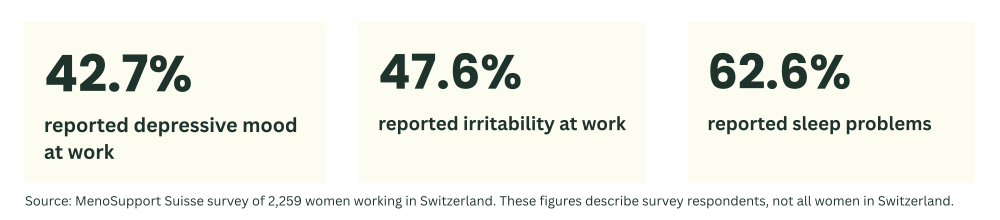
A Swiss workplace survey of 2,259 women found that 42.7% reported low mood and 47.6% reported irritability during menopause (Rumler et al., MenoSupport Suisse, 2025).
Why do these changes happen? And how do hormones, stress and sleep affect mental health during this stage of life?
Research offers some answers. It also shows that every woman’s experience is different.
When you don’t quite feel like yourself
You may feel more anxious than usual, become irritable more easily or lose interest in things you once enjoyed. These changes can feel unsettling, especially when you cannot explain them.
For some women, emotional changes appear alongside irregular periods, night sweats or poor sleep. Others notice changes in their mood before they recognise the physical signs of perimenopause.
The World Health Organization (WHO) explains that most women reach menopause between the ages of 45 and 55. Perimenopause can last several years. During this time, women may notice changes in their physical, emotional and mental wellbeing. Mood changes, anxiety and depression can also occur, although experiences vary from person to person (World Health Organization, Menopause Fact Sheet, 2024).
Women may not always connect these feelings with perimenopause. They might blame work pressure, family responsibilities or everyday stress. Hormonal changes may not even cross their minds.
Understanding the possible links can help women recognise changes and seek the right support.
What happens to hormones during perimenopause?
Perimenopause is the transition leading up to menopause. During this time, ovarian function changes and periods may become irregular. Levels of hormones such as estradiol can also rise and fall.
Estradiol plays a role beyond reproduction. Researchers are studying how changes in this hormone may relate to mood and other emotional symptoms. However, hormones are only one part of the picture.
The Swiss workplace survey found that 71.2% of respondents reported physical or mental exhaustion at work. Another 62.6% reported sleep problems, while 23.6% reported anxiety. Only 12.4% said menopause had not affected their work (Rumler et al., MenoSupport Suisse, 2025).
These figures need careful interpretation. The researchers collected responses online from women who chose to take part. The results therefore do not represent every woman in Switzerland.
Still, the survey highlights the challenges many participants described. Perimenopause may increase vulnerability to emotional difficulties in some women. But hormonal changes do not inevitably lead to mental health problems.
What does the research say about depression risk?
Menopause does not affect every woman in the same way.
The Zurich Study found that mental health difficulties were associated with factors including previous mental health problems and current psychosocial distress, rather than menopausal stage alone. (Rössler et al., World Psychiatry (2016))
Women in Switzerland report depressive symptoms more often than men. The 2022 Swiss Health Survey found that 11.7% of women and 7.9% of men aged 15 and over had moderate to severe depressive symptoms. It also found medium or high psychological distress in 21.1% of women and 14.4% of men (Swiss Federal Statistical Office, Gesundheit: Taschenstatistik 2025).
These figures cover adults of all ages, not just women in midlife. They provide useful context, but they cannot tell us how much perimenopause contributes to this difference.
What did the Zurich Study find?
These figures cover adults of all ages, not just women in midlife. They provide useful context, but they cannot tell us how much perimenopause contributes to this difference.
A Swiss study offers a more specific perspective. The prospective Zurich Study followed 168 women from age 21 to 50. At age 50, hot flushes, night sweats and sleep disturbances were significantly more common among perimenopausal and postmenopausal women. Irritability and nervousness were more common during perimenopause, but this association was explained by neuroticism—a tendency towards negative emotions—measured earlier in life. The transition itself was not associated with changes in the prevalence of major depressive episodes or anxiety disorders.
A long-term Swiss study followed 168 women from age 21 to 50. The researchers examined how mental health changed during the menopausal transition.
At age 50, women in perimenopause or postmenopause reported hot flushes, night sweats and sleep problems more often than other women. The researchers also found a link between perimenopause and irritability or nervousness.
However, an earlier personality trait called neuroticism explained this link. Neuroticism describes a tendency to experience negative emotions more often.
The researchers found no link between the menopausal transition itself and changes in the rates of major depressive episodes or anxiety disorders. Instead, earlier mental health problems, neuroticism and current life stress were linked to mental health difficulties between ages 41 and 50 (Rössler et al., World Psychiatry, 2016, “Does menopausal transition really influence mental health? Findings from the prospective long-term Zurich study”).
The study followed a relatively small group, so it cannot settle the question on its own. Still, it highlights an important point: a woman’s mental health history and current circumstances may matter as much as her stage of menopause. Hormones alone cannot explain every experience.
Why are some women more affected than others?
There is no single explanation for every woman’s experience. Research points to several factors that may work together, including sensitivity to hormonal changes, physical symptoms and life circumstances.
Hormonal sensitivity
Women do not all respond to hormonal changes in the same way. For some, changes in estradiol may have a stronger link to emotional symptoms.
A clinical trial explored this question in 73 healthy women aged 46 to 60. The researchers examined estradiol changes, stressful life events and emotional symptoms during the menopausal transition.
Women with greater changes in estradiol reported more anhedonia, especially if they had experienced more stressful events. Anhedonia means finding less interest or pleasure in things. The researchers also found that a woman’s sensitivity to estradiol changes helped predict her anxiety response to estradiol treatment.
COVID-19 forced the researchers to stop the study early. The findings do not prove that hormonal changes cause anxiety. Nor do they show that hormone therapy suits every woman (Lozza-Fiacco et al., Psychoneuroendocrinology, 2022, “Baseline anxiety-sensitivity to estradiol fluctuations predicts anxiety symptom response to transdermal estradiol treatment in perimenopausal women – A randomized clinical trial”).
This research helps explain why two women at a similar stage of perimenopause may feel very different. It also reminds us not to assume that menopause explains every symptom.
Stress and life circumstances
Midlife can bring many demands at once. You may be managing work, caring for children or ageing parents, dealing with relationship changes or facing financial pressure.
The Zurich Study linked current life stress to mental health difficulties between ages 41 and 50 (Rössler et al., World Psychiatry, 2016).
Work can add to these pressures. In the Swiss workplace survey, 55.4% of respondents said they felt more stressed at work during menopause. Another 66.8% found it harder to concentrate (Rumler et al., MenoSupport Suisse, 2025).
Stress does not explain every emotional symptom. Hormonal changes and life pressures may interact, so it helps to consider both.
Sleep and physical symptoms
Hot flushes and night sweats can interrupt sleep. Poor sleep can then affect concentration, mood and your ability to cope with daily pressures. Anxiety can also make it harder to sleep.
This can create a cycle that feels difficult to break.
The Zurich Study found that sleep problems occurred more often among women in perimenopause and postmenopause (Rössler et al., World Psychiatry, 2016).
Looking at the full picture is more useful than focusing on one possible cause. Emotional symptoms, sleep, physical changes, personal history and current stress all deserve attention.
Understanding hormonal changes can inform care, but it should not replace a thorough assessment of a woman’s symptoms, medical history and circumstances.
Key takeaway from the expert perspectives in this article
Expert voice: Connecting research with care
Serena Lozza-Fiacco: Stress, anxiety and menopause
Serena Lozza-Fiacco works in gynaecological psychiatry at St. Gallen Psychiatry Services. She brings a psychological perspective to menopause care.
With Petra Stute of Inselspital Bern, she co-authored a review on ways to manage stress and anxiety during the menopausal transition. The review examined clinical trials and other research. It also presented decision-making tools to help healthcare professionals assess and manage these symptoms (Stute and Lozza-Fiacco, Maturitas, 2022, “Strategies to cope with stress and anxiety during the menopausal transition”).
Lozza-Fiacco also co-authored a Swiss study protocol that compares three approaches for women in perimenopause who experience hot flushes and insomnia. The researchers plan to compare cognitive behavioural therapy for insomnia (CBT-I), hormone therapy and sleep hygiene.
The protocol explains how the researchers will conduct the study. It does not yet provide results showing which approach works best (Pavicic et al., Trials, 2025, “No more sleepless nights in perimenopause”).
Dr Susanna Weidlinger: Guidance on hormone therapy
Dr Susanna Weidlinger works in the Division of Gynaecological Endocrinology and Reproductive Medicine at Inselspital Bern. She also serves as president of the Swiss Society for Gynaecological Endocrinology, Contraception and Menopause (SGEM).
She co-authored an expert letter from the Swiss Society of Gynaecology and Obstetrics. The letter outlines Swiss recommendations for systemic menopausal hormone therapy. It covers when clinicians may recommend treatment and how they should review it (Stute et al., SGGG Expert Letter No. 90, 2025).
Together, these perspectives highlight an important principle: understanding hormonal changes can help guide care. However, healthcare professionals must also consider a woman’s symptoms, medical history and individual circumstances.
What can help when emotional symptoms appear?
Recognising a change is a useful first step. The next is finding the right support, without assuming that every symptom is caused by perimenopause or that one treatment will work for everyone.
1. Look for patterns
If your mood, anxiety or sleep has changed, try keeping a simple symptom record. Note changes in your menstrual cycle, night sweats, sleep quality and stressful events.
This record cannot identify the cause on its own. However, it may reveal patterns and help you explain your experience during a healthcare appointment.
2. Talk to a healthcare professional
Speak with a healthcare professional if emotional symptoms persist, affect daily life or interfere with work or relationships.
Anxiety and depression deserve proper assessment, even when they occur alongside menopause symptoms. A clinician can explore whether perimenopause plays a role and consider other possible causes.
The Swiss workplace survey found that 46.5% of respondents had sought medical advice for menopause symptoms. Another 44.5% had used hormone therapy, while 10.8% had used psychotherapy (Rumler et al., MenoSupport Suisse, 2025).
3. Explore support options
The right support depends on your symptoms, health history and preferences. Options may include psychological care, cognitive behavioural therapy, treatment for sleep problems or menopausal hormone therapy.
The 2025 Swiss expert letter recommends menopausal hormone therapy for suitable women with menopausal symptoms, provided they have no contraindications. It advises clinicians to use the lowest effective dose and review the treatment every year (Stute et al., SGGG Expert Letter No. 90, 2025).
Hormone therapy can help with certain menopausal symptoms, but it is not suitable for everyone. Its benefits and risks depend on the treatment and a woman’s medical history. A healthcare professional can help her weigh these factors.
The expert letter addresses menopausal symptoms. Suspected depression needs its own assessment and appropriate care.
Researchers may learn more about sleep treatments when the Swiss study comparing CBT-I, hormone therapy and sleep hygiene reports its results. Until then, a healthcare professional can discuss current options based on your symptoms and circumstances (Pavicic et al., Trials, 2025).
4. Support your everyday wellbeing
Regular physical activity, enough sleep, social connection and practical ways to manage stress can all support wellbeing.
These habits can help, but they do not replace professional care when symptoms persist or become severe.
Taking mental health seriously through perimenopause
Perimenopause is a biological transition, but it happens within the context of a woman’s whole life. Hormonal changes may contribute to emotional symptoms. Sleep problems, stress and individual vulnerability may also play a role.
Research does not point to one explanation for every woman. It does show why we should take women’s experiences seriously, ask the right questions and make appropriate care accessible.
A longer life is not the only goal of healthspan. We also want to protect our mental and physical wellbeing as we age. Recognising changes early and finding the right support can help us do that.
Perimenopause deserves the same attention. It is not a stage every woman must struggle through alone. With better understanding and appropriate support, women can make informed choices about their health.
Key References
- World Health Organization. Menopause. Fact sheet, 16 October 2024. https://www.who.int/news-room/fact-sheets/detail/menopause
- Rumler A, Stute P, Pavicic E, Kränzlin S, et al. MenoSupport Suisse: Ergebnisse der ersten schweizweiten Befragung zum Thema Wechseljahre am Arbeitsplatz. Hochschule für Wirtschaft und Recht Berlin / Inselspital Bern / The Women Circle AG. 3 September 2025. https://blog.hwr-berlin.de/menosupportsuisse/wp-content/uploads_menosupportsuisse/2025/10/MenoSupportSuisse_2025.pdf
- Federal Statistical Office (BFS). Gesundheit: Taschenstatistik 2025 (data: Swiss Health Survey 2022). Neuchâtel: BFS; 2025. https://dam-api.bfs.admin.ch/hub/api/dam/assets/34027817/master
- Rössler W, Ajdacic-Gross V, Riecher-Rössler A, Angst J, Hengartner MP. Does menopausal transition really influence mental health? Findings from the prospective long-term Zurich study. World Psychiatry. 2016;15(2):146–154. doi:10.1002/wps.20319.
- Stute P, Lozza-Fiacco S. Strategies to cope with stress and anxiety during the menopausal transition. Maturitas. 2022;166:1–13. doi:10.1016/j.maturitas.2022.07.015.
- Pavicic E, Stute P, Rudzik F, Urech A, Lozza-Fiacco S. No more sleepless nights in perimenopause – an open-label, randomized, parallel-group, active controlled intervention study in perimenopausal women with vasomotor symptoms and insomnia to investigate the efficacy of hormone replacement therapy and cognitive behavioral therapy for the treatment of insomnia: study protocol. Trials. 2025;27(1):94. doi:10.1186/s13063-025-09366-9.
- Stute P, Singer M, Streuli I, Birkhäuser M, Weidlinger S, Bürki R. Aktuelle Empfehlungen zur systemischen menopausalen Hormontherapie (MHT). SGGG Expertenbrief No. 90 (replaces No. 42). Swiss Society of Gynaecology and Obstetrics; 2 January 2025. https://www.sggg.ch/fileadmin/user_upload/Dokumente/3_Fachinformationen/1_Expertenbriefe/De/EB_90_Aktuelle_Empfehlungen_zur_systemischen_Menopausalen_Hormontherapie__MHT_.pdf