
Anti-Ageing Interventions: What the Science Actually Says
Separating evidence-based strategies from expensive myths — a research-led guide to the interventions that genuinely extend healthy life.
KEY FIGURES AT A GLANCE
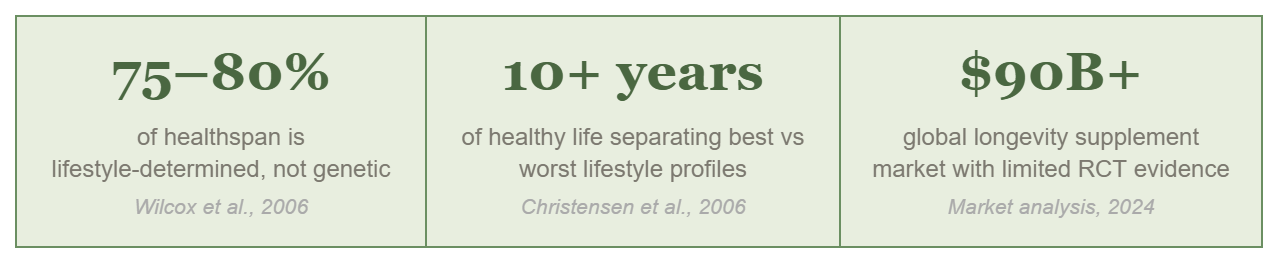
Sources: Wilcox et al., Journals of Gerontology, 2006; Christensen et al., The Lancet, 2006
Almost every week a new supplement, peptide or protocol is launched on the market claiming to reverse your biological clock. The longevity market is worth tens of billions and much of it is built on hope rather than evidence. So what genuinely works? Researchers who study the biology of ageing are increasingly able to answer that question and the findings may surprise you.
Why Most Anti-Ageing Claims Fail the Evidence Test
The core problem is translation. A compound that extends lifespan in yeast, worms or even mice frequently fails in humans not because the biology is wrong, but because human ageing is vastly more complex, longer in duration and entangled with decades of lifestyle, environment and accumulated molecular damage (López-Otín et al., Cell, 2023).
Clinical trials in ageing are also extraordinarily difficult to run: meaningful endpoints take decades and “healthspan” — the period of life spent free from serious disease — is not yet a recognised regulatory endpoint. This creates a vacuum that the supplement industry fills enthusiastically.
The Interventions with Genuine Human Evidence
1. Exercise — The Most Replicated Intervention
No other intervention comes close to the breadth and consistency of evidence for physical activity. Aerobic exercise, particularly at moderate-to-vigorous intensity, reduces all-cause mortality, preserves cognitive function, counteracts sarcopenia (age-related muscle loss) and measurably slows the accumulation of epigenetic ageing marks.
Resistance training independently preserves muscle mass and metabolic function. The effect sizes are clinically meaningful: regular physical activity is associated with a reduction in all-cause mortality comparable to not smoking (Wen et al., The Lancet, 2011). Crucially, these benefits are dose-responsive down to relatively modest activity levels — the largest marginal gains come from moving from sedentary to lightly active. There is no supplement that reproduces this effect profile.
Key statistic: ~35% reduction in cardiovascular mortality with regular moderate exercise vs sedentary lifestyle (Wen et al., The Lancet, 2011)
2. Dietary Patterns — Quality Over Supplementation
Whole dietary patterns, principally the Mediterranean and similar plant-rich diets, consistently outperform isolated nutrient supplementation in longevity trials. The mechanism is multifactorial: polyphenols, fibre, reduced ultra-processed food intake and anti-inflammatory fatty acid profiles work synergistically in ways that a single nutraceutical cannot replicate.
A 2023 meta-analysis confirmed that adherence to a Mediterranean-style diet is associated with reduced biological age as measured by epigenetic clocks (Quach et al., JAMA Internal Medicine, 2022). Caloric restriction, the most robust life-extension intervention in animal models, shows modest benefits in humans in the CALERIE trials: reduced metabolic risk markers and some attenuation of biological ageing, but no confirmed lifespan data yet in humans (Ravussin et al., JAMA Internal Medicine, 2015).
3. Sleep — The Underrated Pillar
Chronic short sleep (under 6 hours per night) accelerates biological ageing as measured by methylation clocks, impairs immune surveillance, elevates cortisol and inflammatory markers, and doubles the risk of cardiovascular events over 10-year follow-up (Cappuccio et al., SLEEP, 2011). Sleep is not a passive state — it is when the glymphatic system clears amyloid, when HGH pulses drive cellular repair and when the immune system consolidates memory. No supplement can meaningfully substitute for its function.
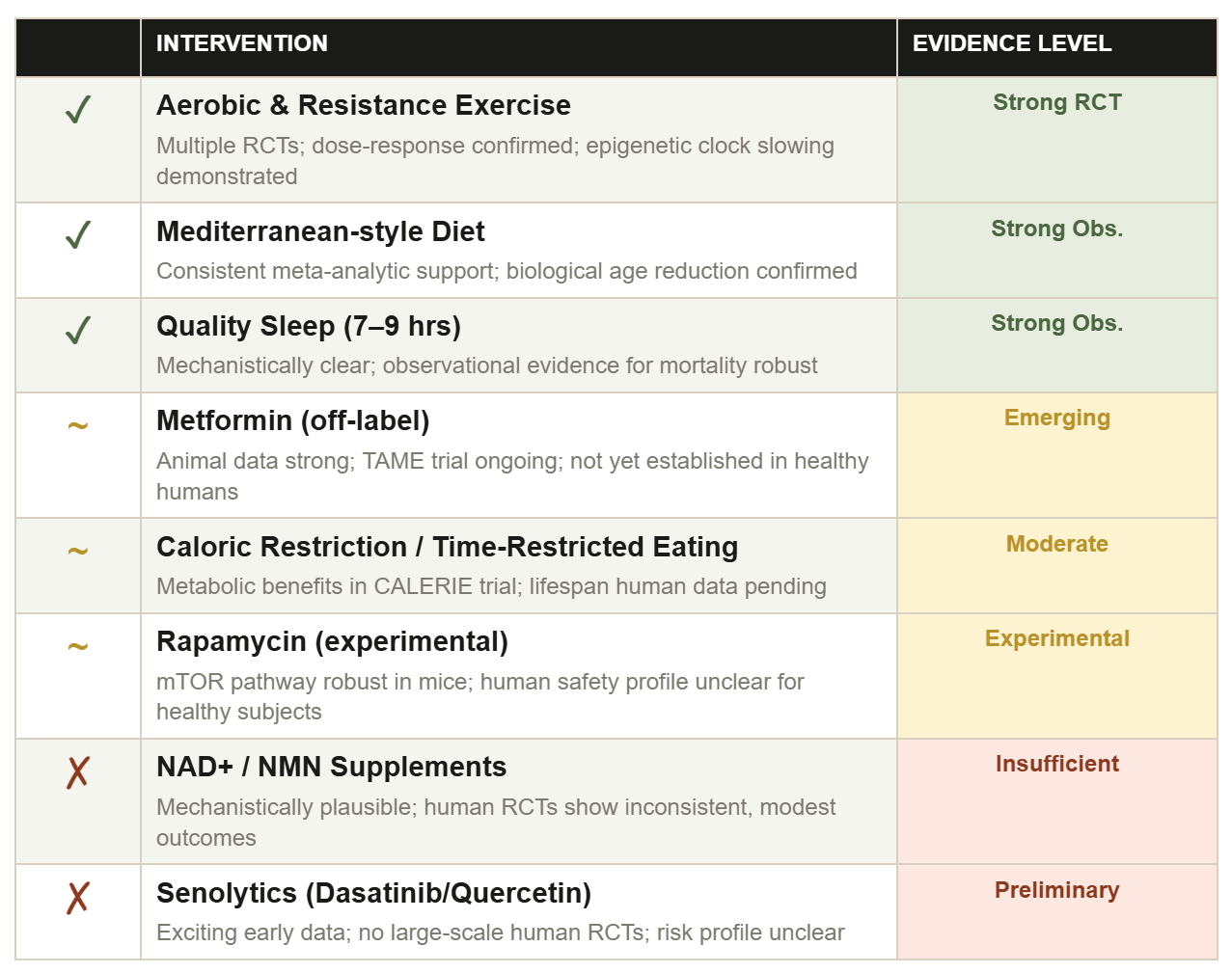
The Evidence Scorecard: Interventions Ranked
An honest appraisal of the current human evidence base, based on peer-reviewed systematic reviews and RCTs.
The Biomarker Question: Can We Measure Ageing?
FROM SURROGATE MARKERS TO FUNCTIONAL MEASURES OF BIOLOGICAL AGE
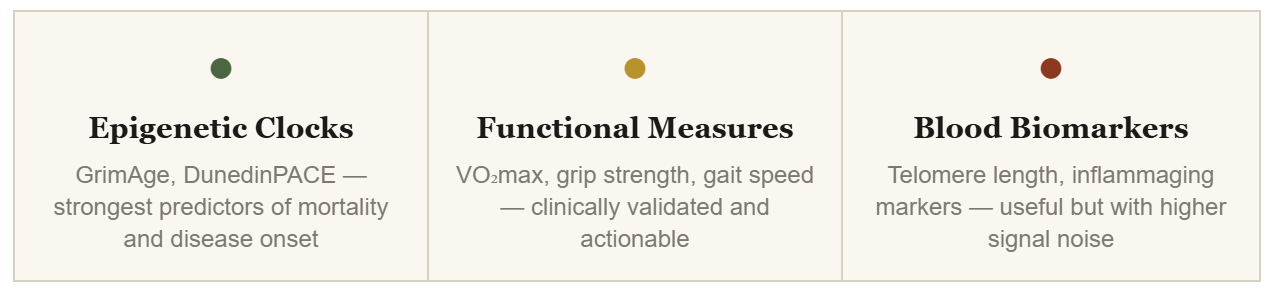
The question “how old am I really?” has a scientific answer, though it is more nuanced than a single number. The most validated tools are epigenetic clocks: algorithms that read DNA methylation patterns across thousands of genomic sites and produce an estimate of biological age. Second-generation clocks, particularly GrimAge and DunedinPACE (Belsky et al., eLife, 2022), predict mortality and disease onset significantly better than chronological age alone.
Crucially, exercise, dietary quality, smoking cessation and sleep optimisation all demonstrably shift these clock readings in the favourable direction, making biological age measurement not just diagnostically interesting, but a tool for validating lifestyle interventions at the molecular level (Handschin et al., Physiological Reviews, 2025).
The Practical Bottom Line
The headline finding from two decades of human ageing research is simultaneously humbling and empowering: the interventions with the strongest evidence are not patentable, are broadly accessible, and have no meaningful side effects. Exercise, dietary quality, sleep, stress management and social connection account for the vast majority of modifiable risk for biological age acceleration.
The pharmaceutical and nutraceutical pipeline is genuinely exciting — metformin’s TAME trial, senolytics, NAD+ precursors — but none have cleared the evidentiary bar for recommendation to healthy adults. That bar exists for good reason. The history of medicine is littered with interventions that worked in a dish and harmed in a patient.
Invest first in the interventions we know work. Watch the pipeline with rigorous interest. And remain sceptical of anyone selling you a shortcut.
AUTHOR
Prof. Dr. Christoph Handschin
The science of ageing interventions is a core research focus of Prof. Dr. Christoph Handschin, Professor and Research Group Leader at the Biozentrum of the University of Basel. His laboratory investigates skeletal muscle plasticity in health and disease, in particular the molecular processes of ageing within and beyond this organ. Prof. Handschin has published landmark reviews examining which pharmacological, chronobiological and exercise-based interventions hold genuine promise for extending human healthspan and which remain fiction.
Key publications:
• Drugs, clocks and exercise in ageing: hype and hope, fact and fiction — Journal of Physiology, 2023. doi:10.1113/jp282887• Biomarkers of aging: from molecules and surrogates to physiology and function — Physiological Reviews, 2025. doi:10.1152/physrev.00045.2024
REFERENCES
1. Handschin C. Drugs, clocks and exercise in ageing: hype and hope, fact and fiction. Journal of Physiology, 2023. doi:10.1113/jp282887
2. Handschin C et al. Biomarkers of aging: from molecules and surrogates to physiology and function. Physiological Reviews, 2025. doi:10.1152/physrev.00045.2024
3. López-Otín C et al. Hallmarks of aging: An expanding universe. Cell, 2023.
4. Belsky DW et al. DunedinPACE, a DNA methylation biomarker of the pace of aging. eLife, 2022.
5. Wen CP et al. Minimum amount of physical activity for reduced mortality. The Lancet, 2011.
6. Wilcox BJ et al. Genetics of exceptional longevity. Journals of Gerontology, 2006.
7. Christensen K et al. Ageing populations: the challenges ahead. The Lancet, 2009.
8. Ravussin E et al. A 2-year randomized controlled trial of human caloric restriction. JAMA Internal Medicine, 2015.
9. Cappuccio FP et al. Sleep duration and all-cause mortality. SLEEP, 2011.